Our intended destination for the day, the Gergeti Sameba church, perched on top of the mountains above Kazbegi.
About this blog
One woman. One man. One ukulele. No direction home. This is our blog about taking some time off working to travel through Georgia, Turkey and across Europe with a couple of backpacks, a travel cribbage set and a beautiful little ukulele.
Showing posts with label Churches. Show all posts
Saturday, 3 November 2012
Hiking in Kazbegi
We got up at a fairly reasonable time for our first full day in Kazbegi and had some delicious breakfast at our guest-house. Nazi's home cooking was awesome! We had really fluffy omelettes and there was lots of bread and cheese available. We also got to try Nazi's famous home-made apple jam which was very tasty. I put sugar on my omelette as I thought it tasted like eggy bread and I always put sugar on that. Everyone thought I was crazy but then what's new? We made some big sandwiches to take hiking with us for lunch and then emerged out into the fresh mountain air.
It was cloudy but still quite sunny when we left the homestay to climb up the steep slope to the Gergeti Sameba (Trinity) Church. We hoped to also hike along the ridge line to the glacier beyond the church but, inevitably, the weather soon changed for the worse. Our short walk around the village the previous day had shown us how unfit we were (especially at that altitude where the air felt so thin) so we decided to take it easy on ourselves and take the longer but more gradual path up to the church. We walked through some woods past an interesting little cemetery with unusual headstones that were life sized carved sculptures of the departed's head. By the time we got to the cemetery it had started raining.
Wednesday, 22 August 2012
Along the Georgian Military Highway to Kazbegi
Every Georgian we'd met so far on our travels had told us that we had to visit Kazbegi because it was the "most beautiful place in Georgia" and had very "healthy air". The original name for this tiny town was Stepantsminda but it was renamed Kazbegi in 1925 during Soviet rule after the famous Georgian writer Alexander Kazbegi who was born there. In 2006, the town officially reverted to its original name but pretty much everybody we met still referred to it as Kazbegi including the marshrutka drivers who drove visitors up there.
Kazbegi is a small town up in the mountains of northern Georgia near the border with Russia. It's located about 1700m above sea level in the Greater Caucasus mountains and is very small with a population of less than 2000. It's scenic location makes it a popular destination for hikers and mountaineering enthusiasts and I'd already seen plenty of beautiful photos of the place long before I even arrived in Georgia so I was very excited about going there armed with my camera.
Kazbegi town nestled among the Caucasus mountains with its most famous landmark the Gergeti Trinity Church perched on the ridge above it.
Tuesday, 21 August 2012
Day trip to Davit Gareja
We got up quite early on our first day back in Georgia after our brief visit to Armenia to go to Davit Gareja, a Georgian Orthodox cave monastery complex near the border with Azerbaijan. The complex is made up of lots of different monastery sites that included monk cells, churches, chapels and other monastic living quarters all cut out of the rock face of Mount Gareja. It is located in the Khaketi region of Georgia, famous for its vineyards and lies about 60-70 km south-east of Tbilisi, Georgia's capital and right on the border with Azerbaijan. In fact, some parts of the monastery are now in Azerbaijan which has led to some border disputes between the two countries. It was founded in the 6th century BC and was once an important centre for religious study and the arts in Georgia but it fell into decline over the centuries as repeated invasions and raids by the Mongol and Persian armies took their toll. More recently, the Soviet army turned Davit Gareja into an artillery training ground and destroyed several historic churches in the process.
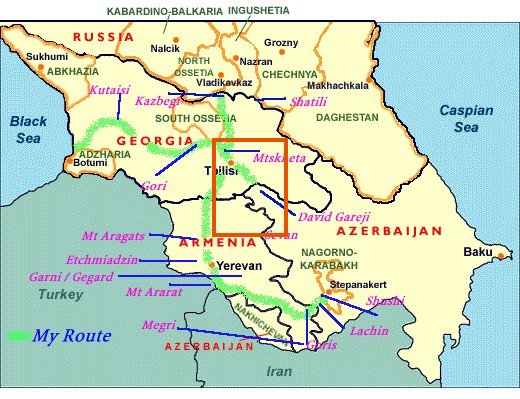
Davit Gareja marked on the map of the Caucasus regions. Its spelt David Gareji here. The spelling of Georgian place names varied a lot due to problems transliterating from the Georgian alphabet to the Latin one.
Thursday, 16 August 2012
Last day in Armenia: Gerghard, Garni and Genocide museum
We got up fairly late as usual on our last day in Armenia and set out for the Armenian Genocide museum by marshrutka (public minibus). It was a very moving museum with a lot of photographs and interesting exhibits about what happened when the ethnically Armenian population were driven out of Turkey by the Ottoman Empire which at that time ruled over Turkey, the Caucasian countries and and most of the Middle East and even parts of north-eastern Africa. The genocide took place during and after World War 1 between 1915 and 1923 and has been generally acknowledged as the first major holocaust of the 20th century.
Between 1 million and 1.5 million Armenians are estimated to have been killed. The extermination of the Armenian population took place in two stages. First the able-bodied men were murdered or worked to death through forced labour then the women, children, elderly and sick were led on death marches into the Syrian dessert and left there with no food or shelter. Many died on the way to the dessert and still more died of starvation and disease once they arrived. Other Christian minorities in the Ottoman Empire were targeted for extermination in a similar way at the this time including the Greeks and the Assyrians.
The remains of Armenians massacred at Erzinjan. (photo care of Wikipedia)
Friday, 3 August 2012
Echmiadzin, The Armenian Vatican City and Ararat Brandy tour
For our third full day in Armenia, we decided to head to Echmiadzin, the country's holy city where the head of the Armenian Apostolic church resides. Echmiadzin was the capital of Armenia between 180 and 340 AD when the country first converted to Christianity and there are several important churches and a cathedral there.
After the previous day's ultra annoying tour group experience, we decided to stick to using public transport so we headed to Kilikia bus station. We caught an ancient gas powered bus to Echmiadzin. The driver had to get out of the bus and go round the back to start it up! It was a really local bus full of people with metal pails full of vegetables and meat staring curiously at us. It took jut over 30 minutes to slowly trundle to Echmiadzin and the driver only had to restart the engine once on the way.
Gas powered local bus with the engine in the back. Many of these buses had spare gas cylinders stored on the roof.
Thursday, 2 August 2012
Armenia - Monasteries, wine and whinging
We went on a tour of southern Armenia for our second day in the country. We don't usually like taking organised tours but decided to put our prejudices aside and accept the inevitable crowds and annoying tour group members in order to try to see more of the country in a short time. However, the tour turned out to be just as irritating as we'd feared - independent travel really is the way to go!
We were picked up by a Hyur Tours car at 9.40am and shuttled over to the main tour bus in front if their office. As expected, it was full of older, richer tourists. The bus was new and had air con though which felt luxurious after the Georgian marshrutkas. Our tour guide woman then proceeded to bellow at us using a microphone in Armenian, Russian and English about any passing sight that might be of interest (and several that were not) almost constantly for an hour until we made our first stop of the trip at Khor Virap, a monastery. The monastery was pretty interesting and was very near the border with Turkey and had good views of Mount Ararat. It also had a deep hole where Saint Gregory the Illuminator was held captive for 13 years before he managed to convince the Armenian king to convert to Christianity, making Armenia the first Christian country. There was also a second, smaller hole which Rowan climbed down but I'm not sure what that was used for, maybe St. Greg's dog. Neither of us got a chance to climb down the biggest as it was too busy. We did see a French woman having a panic attack after climbing out of it though so it must have been good down there.
Khor Virap monastery.
Wednesday, 11 July 2012
First impressions of Yerevan
We arrived in Yerevan, the capital city of Armenia, early in the morning after a tiring overnight train journey from Tbilisi, Georgia. Our first impressions of the city were that it was very hot, very Soviet and just as confusing to arrive in as its Georgian counterpart. Using our (extremely) rudimentary Russian we asked an old guy in the train station where the metro was and went to try to catch a train to the centre. It was very confusing in the metro station as nearly all the signs were in Armenian script which neither of us understand. Luckily, there were a few signs in Russian too which I can read so we caught a train going in the right direction. There wasn't a word of English anywhere so if you didn't know at least a little Russian you'd be in trouble. I knew my degree in Russian history and culture would be useful one day!
The platform at Yerevan statıon early in the morning.
Saturday, 30 June 2012
Armenia - By train to Yerevan
We had train tickets booked for an overnight sleeper train from Tbilisi to Yerevan in Armenia. We woke up quite early (for us) and spent the day exploring some more if Tbilisi's sights. We started with the rather new looking Russian Orthodox church that's located in the next street down from our hostel. There was a service going on when we arrived but we were still allowed in. The inside of the church was ornate as with most Orthodox churches, with lots of gold encrusted icons and paintings of saints. There was some pretty singing going on but we couldn't see the singers. Not sure if it was a cunningly hidden speaker system or if they were behind some screen to one side. A priest gave us some stale tasting pieces of bread and insisted we ate it. Think that means I've ingested a piece of Christ - gross!
Onion shaped dome of the Russian Orthodox church that seems to be currently under construction just like most of Tbilisi.
Friday, 29 June 2012
Mtskheta - Georgia's old capital
On our third full day in Georgia we decided to head out to Mtskheta, one of the oldest cities in the country and the spiritual heart of Georgia with its ancient churches. It's 20km from Tbilisi and just a short bus ride away, perfect for a day trip. We walked to the main train station in Tbilisi called Voksal and bought our tickets for the overnight train to Yerevan in Armenia for the following day. Then we caught the metro to Didube bus station and found the marshrutka to Mtskheta. Marshrutkas are small minibuses that ply the roads of Georgia (and Armenia) linking cities together and driven by guys who get paid by the number of passengers they pick up, which means they usually wait until they fill up which can be inconvenient. They are usually driven very quickly and are very cheap. We paid 1 lari (about 50p or less) to get to Mtskheta and it took about 30 minutes.
Our first stop in Mtskheta was at the Samtavro church just up from the bus stop. This church was built in the 1130's and now forms part of a nunnery. The nunnery was the site of Georgia's first church. Then we walked to the town centre where we visited Svetitskhoveli Cathedral, a compound surrounded by a large crenelated wall.
Smaller older building in the grounds of the Samtavro church.
Tuesday, 26 June 2012
Tbilisi Day 1: Churches, chacha and crumbling grandeur
So we spent our first day in Georgia exploring Tbilisi's many churches, eating lots of cheesy bread, (khachapuri) and getting acquainted with the local firewater called "chacha". We started with some khachapuri for breakfast before heading off on foot across the city towards Liberty Square for a free walking tour.
We noticed several interesting things about Tbilisi just on that first lazy stroll to the centre. One of the first things was that, despite Tbilisi's relatively small size (the population is only about 1 million people), the city seemed very big on art. There was interesting stencilled graffiti everywhere we looked. The other things we noticed were that there seemed to be building works going on all over the place, there were lots of people begging (mainly Romany kids and wizened old Georgians) and there were churches of varying sizes everywhere you looked.
One of the many pieces of stencilled graffiti we saw all over Tbilisi.
Tuesday, 19 June 2012
Last Day in Istanbul - Bosphorous Cruise and more mosques
We woke up late again on our last full day in Istanbul. Most people in our dorm room were late to bed as were we so it couldn't be helped. Your schedule is rather dictated by other people when you stay in a dorm room, especially one as cramped as ours. Our room smelt like a monkey house too as two guys who were cycling across Turkey had moved into our dorm the night before and their bags stank! Not surprising given the extreme heat.
After our usual hostel brekkie we set off for the Eminonu docks to catch a Bosphorous ferry. As you probably already know, Istanbul is famous as it is the only city in the world that is built on two continents, Europe and Asia. The two sides are separated by the Bosphorous Sea. The docks were a bit confusing but after some messing about we decided to get the more expensive 25 lira long circle cruise that would take us way up to some far flung places on the Asian side. There were shorter, cheaper (10 lira) cruises available but we'd just missed one of course. We jumped aboard our big old passenger ferry, grabbed a seat on the outer edge so we could have a good view and settled in for a day of sitting around rather than walking - bliss! We saw lots of jellyfish in the water and cormorants diving for fish. There was plenty of rubbish too unfortunately. Actually, one of the things we noticed about the ferries was how much smoke they poured pout of their chimneys. The smog over the sea was pretty disgusting and hung over Istanbul in a visible pall.
The New Mosque seen from our ferry on the Bosphorous.
Saturday, 16 June 2012
Istanbul Day 1 - Mostly mosques
We woke up on our fırst day in Istanbul to be greeted by a beautiful, but very hot, sunny day. We had a bıt of a late start but it seems that the day starts quite late here anyway gıven the intense heat. The hostel where we are sdtaying provides us with a free breakfast every morning which is a nice touch and Ali, the cheerful owner, makes sure that everyone can eat ıt by having long serving times - 8am to 12pm! Lucky for us!
After plenty of bread, cheese, boiled egg and honey washed down with some Turkish tea and a chat wıth some of the other guests we set off for our first day of sightseeing. Before we even left the hostel we explored the rooftop area whıch gave us a great vıew of the Hagıa Sofia and the Blue Mosque.
Rowan playing one of the 3 tunes he knows on my uke on the hostel roof.
The Hagia Sofia as seen from our hostel roof.
Subscribe to:
Comments (Atom)