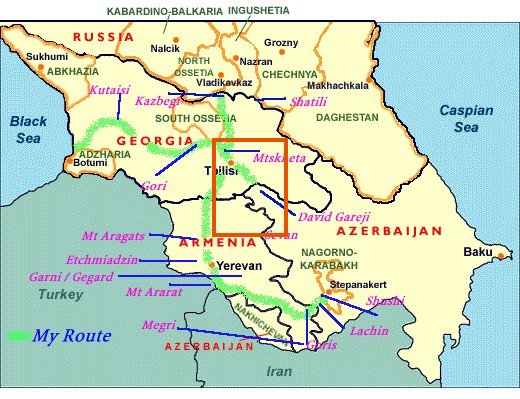
Davit Gareja marked on the map of the Caucasus regions. Its spelt David Gareji here. The spelling of Georgian place names varied a lot due to problems transliterating from the Georgian alphabet to the Latin one.
About this blog
One woman. One man. One ukulele. No direction home. This is our blog about taking some time off working to travel through Georgia, Turkey and across Europe with a couple of backpacks, a travel cribbage set and a beautiful little ukulele.
Showing posts with label Monasteries. Show all posts
Tuesday, 21 August 2012
Day trip to Davit Gareja
We got up quite early on our first day back in Georgia after our brief visit to Armenia to go to Davit Gareja, a Georgian Orthodox cave monastery complex near the border with Azerbaijan. The complex is made up of lots of different monastery sites that included monk cells, churches, chapels and other monastic living quarters all cut out of the rock face of Mount Gareja. It is located in the Khaketi region of Georgia, famous for its vineyards and lies about 60-70 km south-east of Tbilisi, Georgia's capital and right on the border with Azerbaijan. In fact, some parts of the monastery are now in Azerbaijan which has led to some border disputes between the two countries. It was founded in the 6th century BC and was once an important centre for religious study and the arts in Georgia but it fell into decline over the centuries as repeated invasions and raids by the Mongol and Persian armies took their toll. More recently, the Soviet army turned Davit Gareja into an artillery training ground and destroyed several historic churches in the process.
Thursday, 16 August 2012
Last day in Armenia: Gerghard, Garni and Genocide museum
We got up fairly late as usual on our last day in Armenia and set out for the Armenian Genocide museum by marshrutka (public minibus). It was a very moving museum with a lot of photographs and interesting exhibits about what happened when the ethnically Armenian population were driven out of Turkey by the Ottoman Empire which at that time ruled over Turkey, the Caucasian countries and and most of the Middle East and even parts of north-eastern Africa. The genocide took place during and after World War 1 between 1915 and 1923 and has been generally acknowledged as the first major holocaust of the 20th century.
Between 1 million and 1.5 million Armenians are estimated to have been killed. The extermination of the Armenian population took place in two stages. First the able-bodied men were murdered or worked to death through forced labour then the women, children, elderly and sick were led on death marches into the Syrian dessert and left there with no food or shelter. Many died on the way to the dessert and still more died of starvation and disease once they arrived. Other Christian minorities in the Ottoman Empire were targeted for extermination in a similar way at the this time including the Greeks and the Assyrians.
The remains of Armenians massacred at Erzinjan. (photo care of Wikipedia)
Thursday, 2 August 2012
Armenia - Monasteries, wine and whinging
We went on a tour of southern Armenia for our second day in the country. We don't usually like taking organised tours but decided to put our prejudices aside and accept the inevitable crowds and annoying tour group members in order to try to see more of the country in a short time. However, the tour turned out to be just as irritating as we'd feared - independent travel really is the way to go!
We were picked up by a Hyur Tours car at 9.40am and shuttled over to the main tour bus in front if their office. As expected, it was full of older, richer tourists. The bus was new and had air con though which felt luxurious after the Georgian marshrutkas. Our tour guide woman then proceeded to bellow at us using a microphone in Armenian, Russian and English about any passing sight that might be of interest (and several that were not) almost constantly for an hour until we made our first stop of the trip at Khor Virap, a monastery. The monastery was pretty interesting and was very near the border with Turkey and had good views of Mount Ararat. It also had a deep hole where Saint Gregory the Illuminator was held captive for 13 years before he managed to convince the Armenian king to convert to Christianity, making Armenia the first Christian country. There was also a second, smaller hole which Rowan climbed down but I'm not sure what that was used for, maybe St. Greg's dog. Neither of us got a chance to climb down the biggest as it was too busy. We did see a French woman having a panic attack after climbing out of it though so it must have been good down there.
Khor Virap monastery.
Subscribe to:
Comments (Atom)